Akita Silk Textiles: The Combination of Tradition and Natural Dyeing
Akita Hachijo

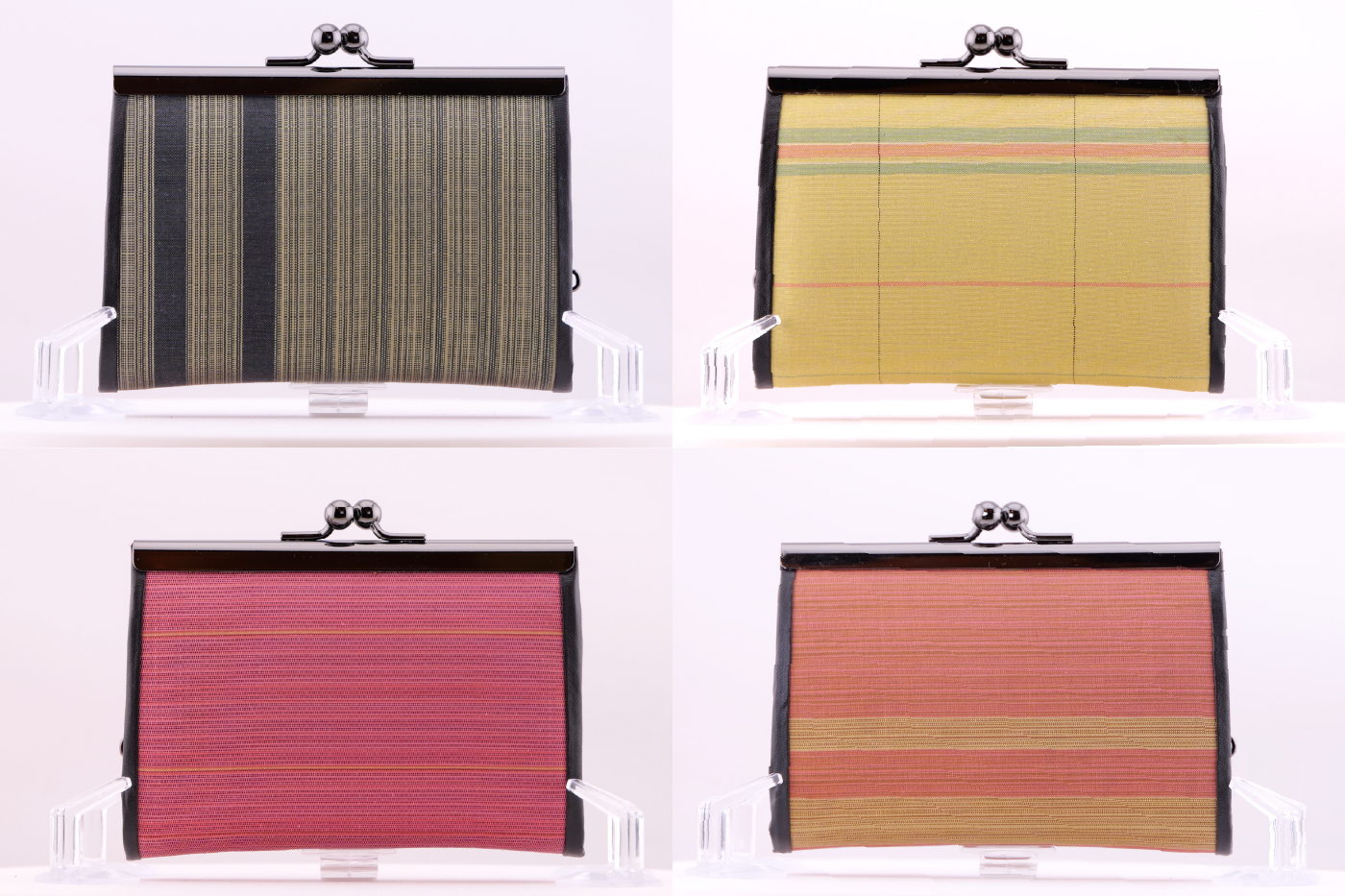
A traditional plant-dyed silk fabric representing Akita Prefecture, born in the Edo period and with a history of over 230 years.
It is characterized by a variety of checkered and striped designs woven into the three basic colors of brown, yellow, and black.
The extremely fine silk thread gives it a fine texture and an elegant luster.
It is used not only for traditional kimonos, but also for making accessories such as bags, ties, wallets, and card cases.
Origin
Akita Prefecture
history
1784~ (Edo period)
manufacturer
Akita Hachijo Hamanasu Workshop Narata Toshiko
designation
Traditional Crafts (Ministry of Economy, Trade and Industry)
Contemporary Master Craftsman (Ministry of Health, Labour and Welfare)


The charm of Akita Hachijo

Subdued colors derived from natural plant dyes
Unique robin color
The dark brown, one of the base colors, is made from the bark and roots of the rosehip tree that grows wild on the coast of the prefecture. Akita Hachijo is the only place in Japan where textiles are dyed with rosehip.

Each roll has a unique woven pattern
One-of-a-kind woven pattern
The combination of 1,800 warp threads and weft threads allows for an infinite number of woven patterns.
It is rare that two identical textiles are produced.
Each roll has a unique woven pattern, so find the perfect piece for you.
「魅力③サブタイトル(~20文字)」
「魅力③タイトル(~10文字)」
「魅力③本文(100~200文字)」
「魅力④サブタイトル(~20文字)」
「魅力④タイトル(~10文字)」
「魅力④本文(100~200文字)」
「魅力⑤サブタイトル(~20文字)」
「魅力⑤タイトル(~10文字)」
「魅力⑤本文(100~200文字)」
「魅力⑥サブタイトル(~20文字)」
「魅力⑥タイトル(~10文字)」
「魅力⑥本文(100~200文字)」
The history of Akita Hachijo
「短いラベル(~15文字)」
「正確な年号(xxxx年)or時期(〇〇時代orxxx~xxx年) 」
「説明文(200~400文字)」
「短いラベル(~15文字)」
「正確な年号(xxxx年)or時期(〇〇時代orxxx~xxx年) 」
「説明文(200~400文字)」
「短いラベル(~15文字)」
「正確な年号(xxxx年)or時期(〇〇時代orxxx~xxx年) 」
「説明文(200~400文字)」
「短いラベル(~15文字)」
「正確な年号(xxxx年)or時期(〇〇時代orxxx~xxx年) 」
「説明文(200~400文字)」
「短いラベル(~15文字)」
「正確な年号(xxxx年)or時期(〇〇時代orxxx~xxx年) 」
「説明文(200~400文字)」
「短いラベル(~15文字)」
「正確な年号(xxxx年)or時期(〇〇時代orxxx~xxx年) 」
「説明文(200~400文字)」
「短いラベル(~15文字)」
「正確な年号(xxxx年)or時期(〇〇時代orxxx~xxx年) 」
「説明文(200~400文字)」
「短いラベル(~15文字)」
「正確な年号(xxxx年)or時期(〇〇時代orxxx~xxx年) 」
「説明文(200~400文字)」
「短いラベル(~15文字)」
「正確な年号(xxxx年)or時期(〇〇時代orxxx~xxx年) 」
「説明文(200~400文字)」
「短いラベル(~15文字)」
「正確な年号(xxxx年)or時期(〇〇時代orxxx~xxx年) 」
「説明文(200~400文字)」
「工芸品名」の制作過程

#1 Collecting plants for dyes
The dyes used at Akita Hachijo are mainly extracted from natural plants found within Akita Prefecture.
[Rosan rose (Rosa rugosa/Rosaceae)]
The roots and bark of the Rugosa rose, which grows wild on the coast, are used as dye to create a brownish color called "Tobihachi."
[Calliaceae (Poaceae)]
The dye is made from the wild plant Kariyasu, and is used to dye the fabric a bright yellow called "Kihachi."
Title
Use this text to share information about your brand with your customers. Describe a product, share announcements, or welcome customers to your store.

#2 Boiling the dye
To extract the color from the plants, they boil them in a large pot to create a dye solution.
1. Boil the roots and bark of the rosehip tree in a large pot. 2. Strain the resulting liquid and prepare it as a dye. 3. Similarly, boil karyas to make a yellow dye.

#3 Dyeing the silk thread
Using the extracted dye solution,
We dye raw silk (silk thread).
[Rosan rose dyeing - Tobihachi]
1. The dyed threads are placed in a hemp bag and boiled in hot water. 2. The color is fixed through stages, from temporary dyeing to final dyeing. 3. The threads are dried to prevent them from tangling.
[Kariyasu dyeing, yellow eight]
1. The raw silk is washed in water to remove starch and other impurities, and then prepared. 2. The thread is immersed in boiled kariyasu liquid and dyed. 3. The process of shaking the thread up and down is repeated to allow the dye to soak in. 4. The thread is slowly moved until the dye cools down, allowing the color to soak in. 5. Wood vinegar or other liquids are sometimes added to give the fabric a greenish color.

#4 Warping
Warping (winding threads) is an important process before weaving.
The dyed thread is wound onto a wooden frame called a "kasegi" and the tension is adjusted.
Prepare the yarns by type and color.

#5 Stretching the warp threads onto the loom
The warp threads are passed through the heddle and reed by hand one by one.
A 39cm wide roll of fabric requires approximately 1,800 warp threads to be threaded through it, so it takes 3 to 4 days for the fabric to be carefully stretched.
The weft thread can be passed through by moving the two heddles.
Also, "reed" refers to the bar that brings the weft threads to the front.
#6 Weaving
The weft threads are woven into the prepared warp threads to create stripes, checkered patterns, etc.
It takes about one week to ten days to weave one bolt (approximately 13 meters) of fabric.
The weft (horizontal) threads are woven using an automatic shuttle, and careful checking is required to ensure that no stitches are skipped or the silk threads are broken.
#7 Completion of the roll of fabric
The basic colors are "Tobihachi (brown)," "Kohachi (yellow)," and "Kurohachi (black)," and the fabric comes in simple designs such as solid colors, stripes, and checkered patterns.
The woven cloth has a glossy finish and becomes softer and more conforms to the body the more it is used.