Akita Silk Textiles: The Combination of Tradition and Natural Dyeing
Akita Hachijo
A traditional plant-dyed silk fabric representing Akita Prefecture, born in the Edo period and with a history of over 230 years.
It is characterized by a variety of checkered and striped designs woven into the three basic colors of brown, yellow, and black.
The extremely fine silk thread gives it a fine texture and an elegant luster.
It is used not only for traditional kimonos, but also for making accessories such as bags, ties, wallets, and card cases.
Origin
Akita Prefecture
history
1784~ (Edo period)
manufacturer
Akita Hachijo Hamanasu Workshop Narata Toshiko
designation
Traditional Crafts (Ministry of Economy, Trade and Industry)
Contemporary Master Craftsman (Ministry of Health, Labour and Welfare)


The charm of Akita Hachijo

Subdued colors derived from natural plant dyes
Unique robin color
The dark brown, one of the base colors, is made from the bark and roots of the rosehip tree that grows wild on the coast of the prefecture. Akita Hachijo is the only place in Japan where textiles are dyed with rosehip.
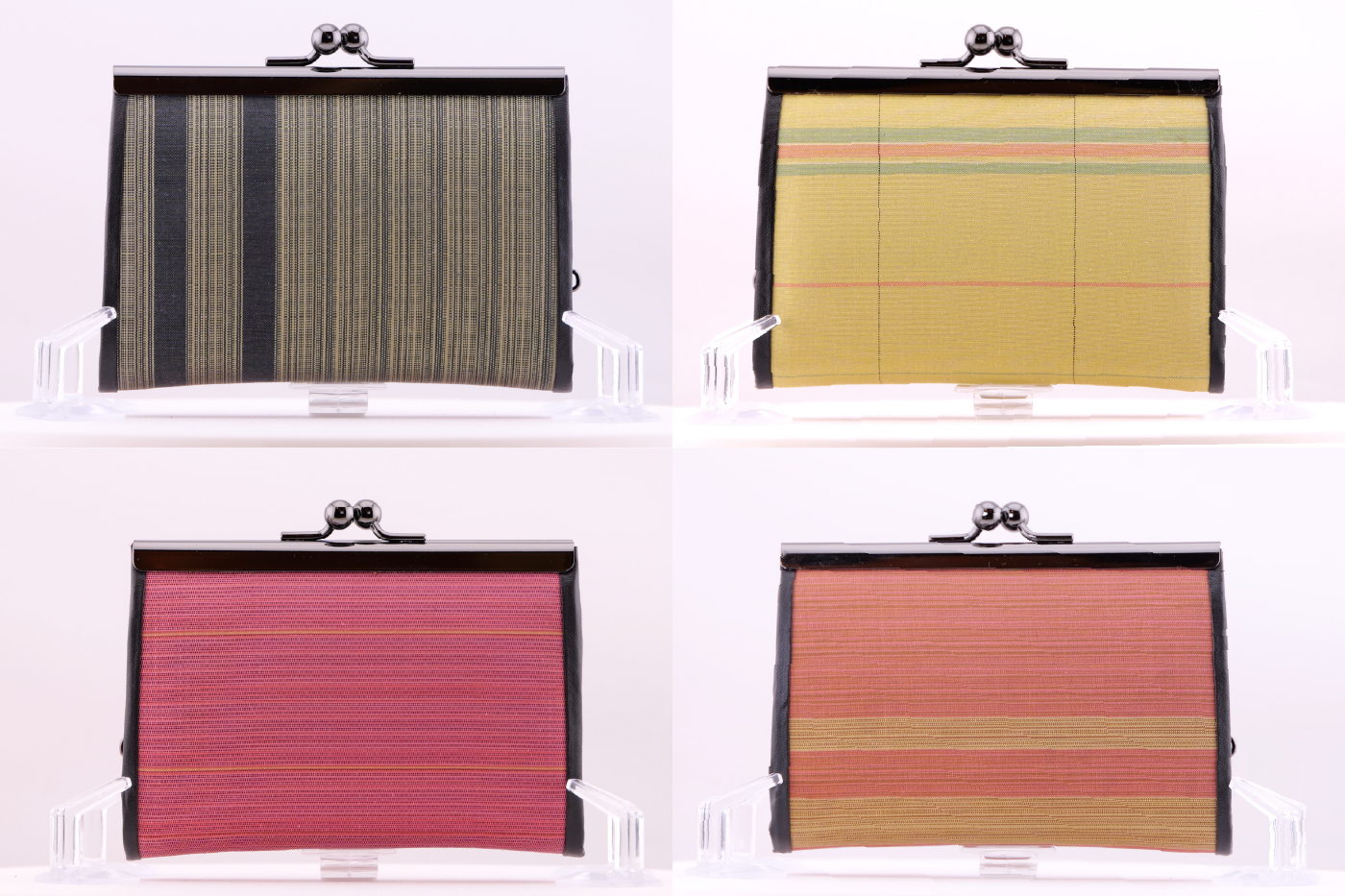
Each roll has a unique woven pattern
One-of-a-kind woven pattern
The combination of 1,800 warp threads and weft threads allows for an infinite number of woven patterns.
It is rare that two identical textiles are produced.
Each roll has a unique woven pattern, so find the perfect piece for you.

The lustre comes from carefully weaving extremely fine silk threads
Surface texture and gloss
It takes one week to ten days to weave one bolt (approximately 13m) of fabric, with 1,800 warp threads and one weft thread threaded individually, creating a soft, fine texture and a glossy surface.The extremely fine silk threads also make the fabric light and easy to handle.
The history of Akita Hachijo

1784年(江戸時代)
陸奥仙台藩より伝えられる
陸奥仙台藩の石川滝右衛門により伝えられたといわれています。
秋田藩は1792年に滝右衛門を物産方(特産物を扱う役所)として、養蚕・織物・漆などの物産振興を図りました。

1814年(江戸時代)
秋田八丈の誕生
上州桐生(現在の群馬県)から蓼沼甚平を招聘し、染色畝織・竜紋織・黄八丈織の染織業を起こし、さらに改良工夫がなされ秋田八丈が誕生しました。
滝右衛門の伝えた技法に蓼沼のもたらした桐生の妙味を加え、金易右衛門(こんやすえもん)、関喜内(せききないら)の協力により、県内の海岸地帯に自生する「ハマナス」の根を染料として風雅な味わいのある鳶色(とびいろ)をつくりだすことに成功しました。

1894年(明治時代)
最盛期の後に衰退
明治時代を最盛期とし、明治27年頃には、秋田市内に27,8軒もの機業場(はたおりば)があり、年間6万反もの織物が織られた時もありましたが、日露戦争後の大不況により廃業する者が続出しました。
以後、社会の西欧化、近代化、二度の世界大戦という大きな時代の流れとともに衰退をたどり、大正時代には、妹尾謙治、佐藤房太郎、滑川五郎(滑川機業場・初代)と数えるのみとなり、昭和4年以降は滑川五郎のみになりました。

1980年(昭和55年)
秋田県無形文化財に指定
秋田八丈・秋田畝織は、秋田県無形文化財(保持者・滑川晨吉)に指定されました。
しかし、2003年11月に唯一操業していた滑川機業場(秋田市)が廃業し、一時生産が途絶えました。
写真は左から、滑川機業場で製造に従事していた奈良田登志子、滑川晨吉。
2006年(平成18年)
奈良田登志子により再興
滑川晨吉のもと製造業務に従事していた奈良田登志子が滑川晨吉より機材一式を譲り受け、2006年に北秋田市に「秋田八丈ことむ工房」を創設し、途絶えていた秋田八丈の技術を復活させました。
現在は唯一の伝承者として秋田八丈の伝統技術を守りつつ、現代の感性も取り入れた製品づくりを実践しています。

2023年(令和5年)
改名と後継者の育成
2023年4月に工房を北秋田市綴子糠沢に移したことをきっかけに、工房名を「秋田八丈 はまなす工房」と名前を改め、同年の9月から地域おこし協力隊の藤原健太郎を後継者として迎えました。
奈良田登志子は伝統の技を磨いて藤原健太郎に継承することで、秋田八丈の未来へつなぐ活動を進めています。
写真は左から、藤原健太郎、奈良田登志子。
秋田八丈の制作過程

#1 Collecting plants for dyes
The dyes used at Akita Hachijo are mainly extracted from natural plants found within Akita Prefecture.
[Rosan rose (Rosa rugosa/Rosaceae)]
The roots and bark of the Rugosa rose, which grows wild on the coast, are used as dye to create a brownish color called "Tobihachi."
[Calliaceae (Poaceae)]
The dye is made from the wild plant Kariyasu, and is used to dye the fabric a bright yellow called "Kihachi."

#2 Boiling the dye
To extract the color from the plants, they boil them in a large pot to create a dye solution.
1. Boil the roots and bark of the rosehip tree in a large pot. 2. Strain the resulting liquid and prepare it as a dye. 3. Similarly, boil karyas to make a yellow dye.

#3 Dyeing the silk thread
Using the extracted dye solution,
We dye raw silk (silk thread).
[Rosan rose dyeing - Tobihachi]
1. The dyed threads are placed in a hemp bag and boiled in hot water. 2. The color is fixed through stages, from temporary dyeing to final dyeing. 3. The threads are dried to prevent them from tangling.
[Kariyasu dyeing, yellow eight]
1. The raw silk is washed in water to remove starch and other impurities, and then prepared. 2. The thread is immersed in boiled kariyasu liquid and dyed. 3. The process of shaking the thread up and down is repeated to allow the dye to soak in. 4. The thread is slowly moved until the dye cools down, allowing the color to soak in. 5. Wood vinegar or other liquids are sometimes added to give the fabric a greenish color.

#4 Warping
Warping (winding threads) is an important process before weaving.
The dyed thread is wound onto a wooden frame called a "kasegi" and the tension is adjusted.
Prepare the yarns by type and color.

#5 Stretching the warp threads onto the loom
The warp threads are passed through the heddle and reed by hand one by one.
A 39cm wide roll of fabric requires approximately 1,800 warp threads to be threaded through it, so it takes 3 to 4 days for the fabric to be carefully stretched.
The weft thread can be passed through by moving the two heddles.
Also, "reed" refers to the bar that brings the weft threads to the front.
#6 Weaving
The weft threads are woven into the prepared warp threads to create stripes, checkered patterns, etc.
It takes about one week to ten days to weave one bolt (approximately 13 meters) of fabric.
The weft (horizontal) threads are woven using an automatic shuttle, and careful checking is required to ensure that no stitches are skipped or the silk threads are broken.
#7 Completion of the roll of fabric
The basic colors are "Tobihachi (brown)," "Kohachi (yellow)," and "Kurohachi (black)," and the fabric comes in simple designs such as solid colors, stripes, and checkered patterns.
The woven cloth has a glossy finish and becomes softer and more conforms to the body the more it is used.